Two-Day Workshop on “Cube Satellite – Mission Design and Challenges”
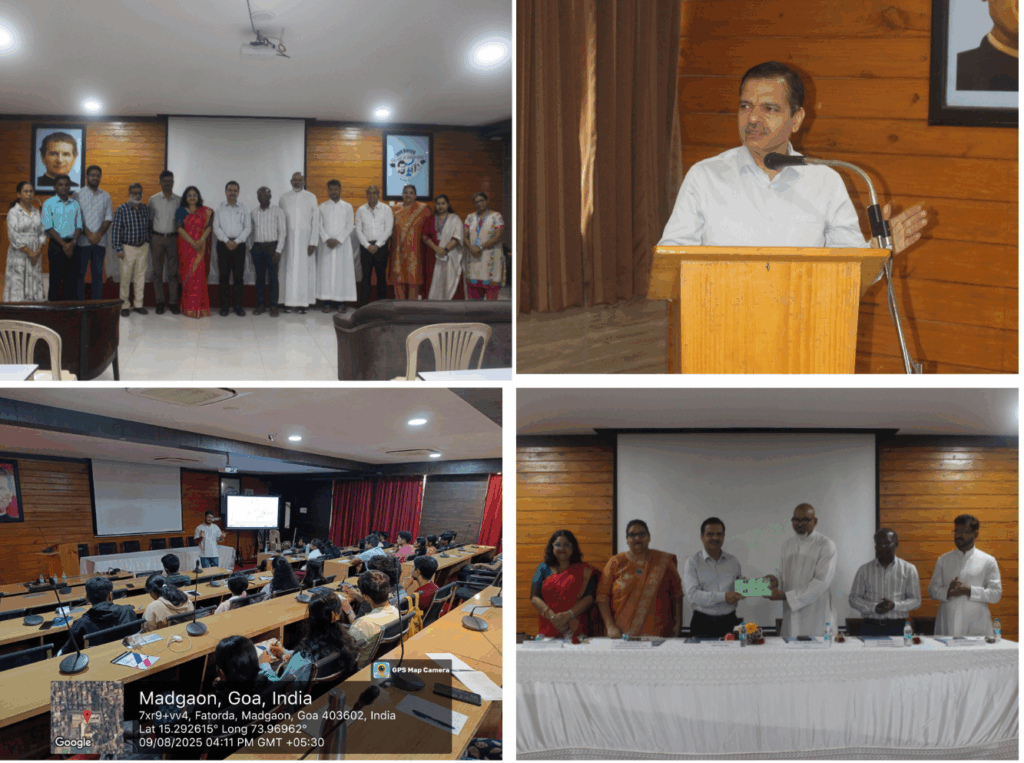
A two-day workshop on Cube Satellite – Mission Design and Challenges was successfully organized on 8th and 9th August 2025 at Don Bosco College of Engineering (DBCE), Goa. The event was conducted by the Goa State Higher Education Council, in collaboration with the Government College of Arts, Science and Commerce, Quepem, the Parikrama Student Satellite Club, and the Electronics and Computer Science Department, DBCE.
The workshop aimed to equip participants with comprehensive knowledge on CubeSat mission planning, design, development, and operational challenges, blending expert lectures with practical demonstrations. A total of 70 applications were received, of which 45 participants were selected as there were limited seats from institutions such as Goa Engineering College, Carmel College, Government College Quepem, DMC College Mapusa, and Goa University, spanning undergraduate to postgraduate levels. In addition to students, industry experts and members of the Goa Ham Radio Society Club also participated, bringing valuable perspectives and practical knowledge to the discussions.
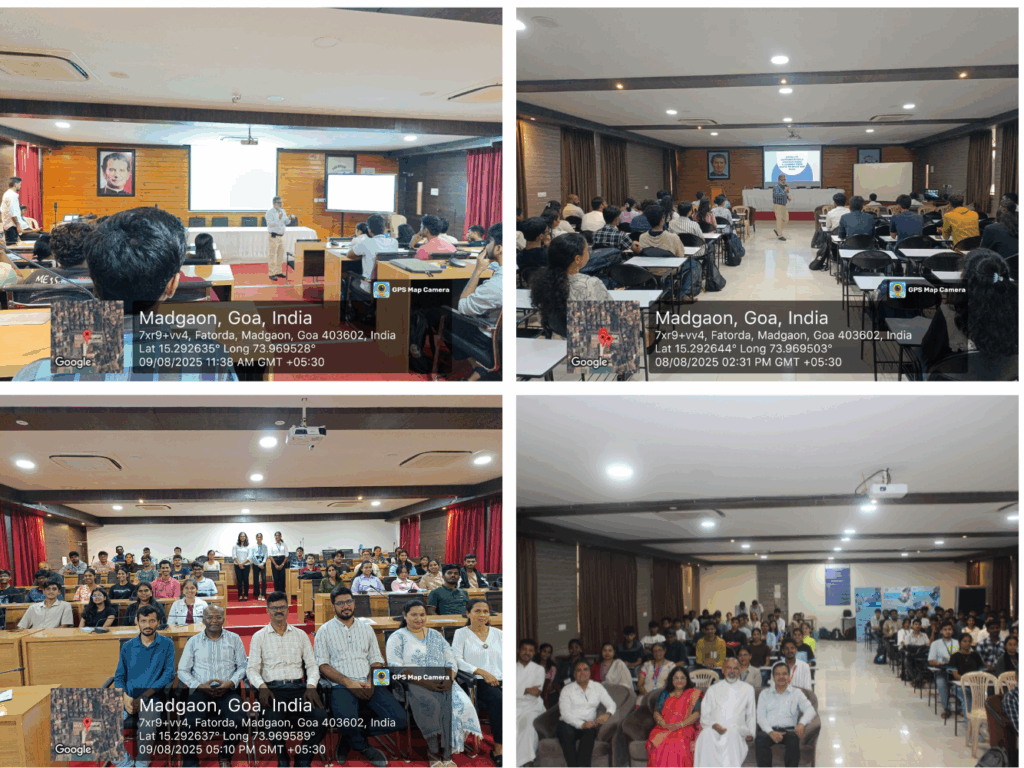
Day 1 – 8th August 2025
The day began with a formal function attended by dignitaries on and off the dais. Present on the dais were:
- Dr. Neena S. P. Panandikar, Principal, DBCE
- Fr. Ralin De Souza, Rector, DBCE
- Fr. Leo Pereira, Administrator, DBCE
- Dr. Pravina Kerkar, Principal, Government College of Arts, Science and Commerce, Quepem
- Shri Bhushan K. Savaikar, Director, Directorate of Higher Education (DHE)
- Dr. Vithal Tilvi, Professor, Directorate of Higher Education (DHE)
- Dr. Niyan Marchon, Professor, Directorate of Higher Education (DHE)
- Dr. Mohini Naik Gadekar, Workshop Co-ordinator, DBCE
- Ms. Liana da Costa, Workshop Co-ordinator, GCQ
The program began with a welcome address by Dr. Neena S. P. Panandikar, followed by Fr. Ralin De Souza who emphasized the role of institutions in fostering research-oriented learning. An introduction to the workshop by given by Dr. Mohini Naik Gadekar, who outlined its objectives and expected outcomes. Dr. Pravina Kerkar appreciated the collaboration between colleges in bringing advanced learning opportunities to students. Shri Bhushan K. Savaikar highlighted the Directorate’s vision for strengthening Goa’s presence in space research and innovation. The formal function concluded with a vote of thanks by Ms. Liana da Costa, Associate Professor, Government College Quepem.
The first technical session was delivered by Dr. Umesh Shinde (Dean R&D, K J Somaiya Inst of technology), who introduced participants to Cube Satellites – Concepts, Configurations & Applications. He explained the evolution of CubeSat standards, modular designs, and their uses in Earth observation, scientific experiments, and communication. Dr. Shinde also discussed how miniaturization and cost reduction are making CubeSats accessible for student-led missions.
This was followed by Prof. C. S. Kulkarni (General Secretary & Custodian, Club for Radio Operation & Wireless Network, Mumbai), who presented on HAM Radio Communication for Small Satellites. He explained the fundamentals of amateur radio in space communications, the role of HAM radio operators in tracking and communicating with satellites, and the integration of amateur bands into CubeSat missions. His talk included practical examples from university-led satellite projects and highlighted the value of HAM radio expertise in mission success.
In the afternoon, Dr. Niraj Patil (Avionics Engineer, New Leap Lab, Mumbai) conducted a Hands-On Training: RF Routing and PCB Design for Small Satellites. He provided an in-depth explanation of RF signal paths, impedance control, and layout considerations for high-frequency circuits in satellite systems. Participants were introduced to PCB design tools, schematic capture, and routing techniques specifically for CubeSat payloads and communication modules. The session bridged theoretical RF concepts with practical PCB implementation, giving attendees a strong foundation for designing reliable RF hardware.
Day 2 – 9th August 2025
The second day began with Prof. C. S. Kulkarni , he conducted a Ground Station Hands-on session. He explained the basics of antenna theory and design, including types of antennas used for small satellites, gain considerations, polarization, and tracking requirements.
In the next session, Er. Chaitanya Kasambe (Avionics System Engineer, ReOrbit Space, Helsinki, Finland) presenting on Indigenous Development in Small Satellites. He outlined how Indian universities and startups are contributing to satellite avionics innovation, discussed system architecture for robust CubeSat design, and shared his experience in developing reliable on-board electronics for mission-critical applications.
In the afternoon, Er. Rohit Bokade (Technical Solution Engineer, Google; Founder, New Leap Lab) delivered an in-depth session on Satellite Ground Station & Satellite Engineering: Designing Products and Beyond. He explained the process of designing and building satellite ground stations, from antenna selection and placement to signal reception and tracking. He also discussed the engineering process behind satellite-related products, including design iteration, prototyping, and testing, sharing industry-level practices and lessons learned from his own work. His talk connected theoretical design concepts with practical product development strategies, making it highly relevant to aspiring satellite engineers.
The day ended with concluding remarks by Dr. Mohini Naik Gadekar, who summarized the key takeaways from all sessions, appreciated the active involvement of participants, and encouraged them to take forward the knowledge gained into academic projects and research initiatives.
The workshop successfully combined theoretical learning with practical exposure, enabling participants to gain both conceptual clarity and applied skills in CubeSat technology. Positive feedback was received, with many attendees expressing a desire for similar programs in the future.
The entire workshop was coordinated by Dr. Mohini Naik Gadekar, DBCE and Ms. Liana da Costa, GCQ ensuring seamless execution of all sessions and activities.


 Visit Today : 485