Online Training on MIDAS GEN for Analysis and Design of Mid-Rise Concrete Buildings
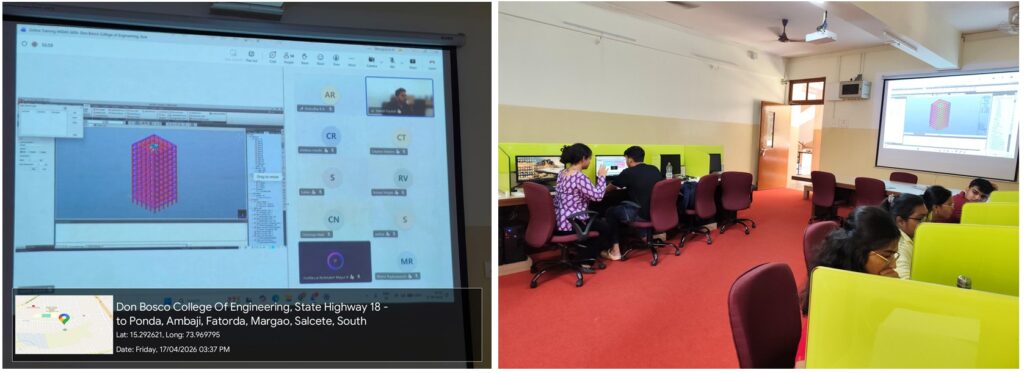
An online training session on “Analysis and Design of Mid-Rise Concrete Buildings using MIDAS GEN” was successfully conducted on 17th April 2026 for the final-year Civil Engineering students of Don Bosco College of Engineering, Fatorda.
The training was coordinated by Prof. B. R. Anirudha, Assistant Professor, Department of Civil Engineering. The session was delivered by Mr. Harish Equbal, Structural Engineer at MIDAS IT India, who served as the resource person.
The objective of the training was to provide students with practical exposure to industry-relevant structural analysis and design software, thereby bridging the gap between theoretical concepts and real-world engineering applications. The session focused on the modelling, analysis, and design of reinforced concrete mid-rise buildings using MIDAS GEN.
The session commenced with an introduction to the MIDAS GEN interface and its applications in structural engineering. Students were guided through the step-by-step modelling of a reinforced concrete building using beam elements, with emphasis on practical modelling techniques and industry practices.
The resource person further explained the importance of defining appropriate boundary conditions and constraints to ensure accurate structural behaviour. This was followed by a session on loading, where students learned about the application of various load cases and combinations as per relevant design standards, and the subsequent execution of structural analysis.
A key highlight of the training was the demonstration of result interpretation. Students learned how to analyse displacements, internal forces, and stress distributions. The session also covered reinforced concrete design procedures using MIDAS GEN, along with its integration with Design+ for detailed design checks.
The training concluded with the generation of a comprehensive design report, demonstrating how software tools can be effectively used to produce professional engineering documentation.
The session was highly interactive, with active student participation and doubt clarification. Overall, the training provided valuable insights into practical structural engineering workflows and significantly enhanced students’ preparedness for professional practice.


 Visit Today : 251