BE Civil Students Explore Modern Engineering and Sustainable Architecture
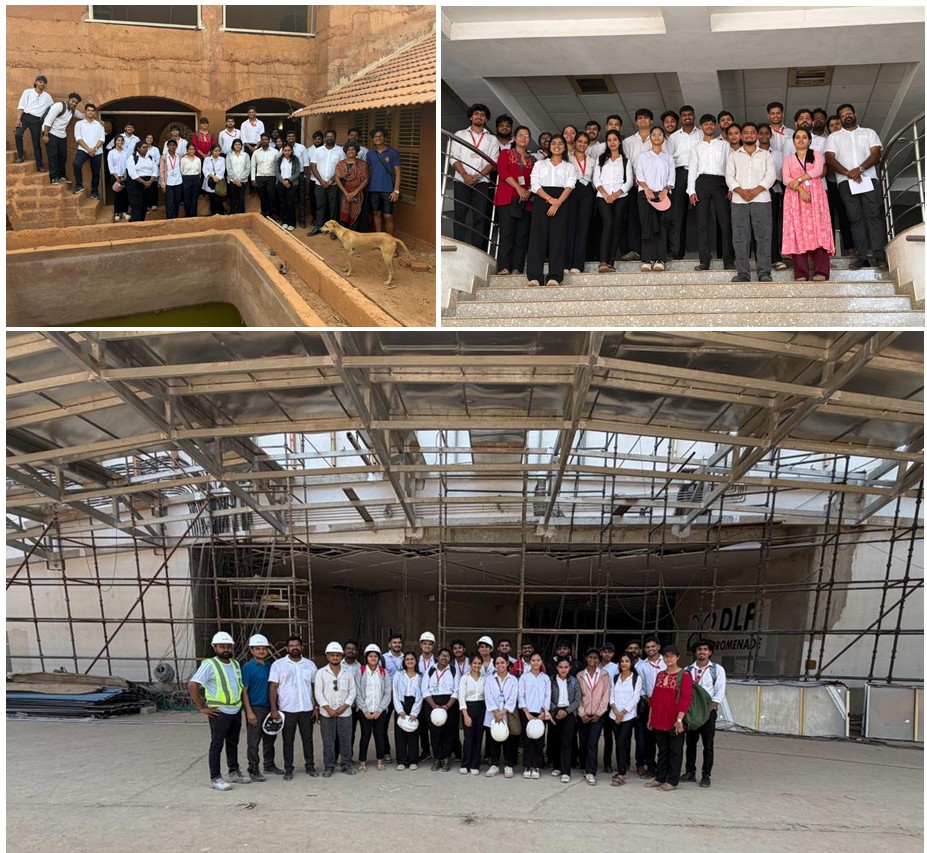
The Department of Civil Engineering organized an insightful field visit for the Final Year (BE) students on March 12, 2026. The tour offered a unique contrast in engineering philosophies, taking students from a high-tech commercial development in Panjim to a traditional, eco-friendly residential project in Goa Velha.
Segment 1: High-Rise Modern Engineering at DLF Mall, Patto
The first leg of the visit took students to the massive DLF Mall construction site at Patto, Panjim. Designed by ABP Architects with structural engineering handled by JW Consultants LLP, the project stands out for its beach-inspired architectural theme and cutting-edge structural systems.
Key Technical Takeaways:
- Hybrid Structural Systems: The building dynamically combines conventional RCC with Post-Tensioned (PT) concrete systems to facilitate massive column-free spaces and longer spans.
- Heavy Load Distribution: Students observed PT beams with depths of $900\text{ mm}$ to $1000\text{ mm}$ and thick PT slabs ($350\text{ mm}$ to $400\text{ mm}$) engineered to support extreme commercial loads, including heavy escalator units.
- Zoning & Smart Logistics: The site engineers explained how dividing the mega-structure into independent zones ensures efficient load management and smooth construction scheduling.
- Massive Infrastructure: The project also features a multi-level basement parking system designed to accommodate around 800 stacked parking spaces.
Segment 2: Sustainable Mud Architecture at Batim
The second visit shifted focus toward traditional, low-carbon engineering at a sustainable housing site in Batim. Associated with the Tambdimati initiative and designed by renowned eco-architect Tallulah D’Silva, this project offered a masterclass in green building practices.
Key Technical Takeaways:
- Zero-RCC Load-Bearing Walls: The structure completely avoids steel and conventional concrete. Instead, it relies on load-bearing walls thicker than $30\text{ cm}$ crafted from a composite mixture of red mud, soorkhi (burnt clay powder), and fermented cow dung for enhanced natural binding and durability.
- Thermal Comfort & Passive Ventilation: The thermal mass of the mud walls, combined with traditional Mangalore clay roof tiles, creates a naturally cool indoor climate. Louvered panels on repurposed wooden doors and windows optimize cross-ventilation.
- Geometric Strength: In the absence of RCC lintels and beams, the structure relies on time-tested architectural elements like structural masonry arches and circular openings to distribute loads safely.


 Visit Today : 482