Training Program on “Applications of Artificial Intelligence and Machine Learning in Civil Engineering”
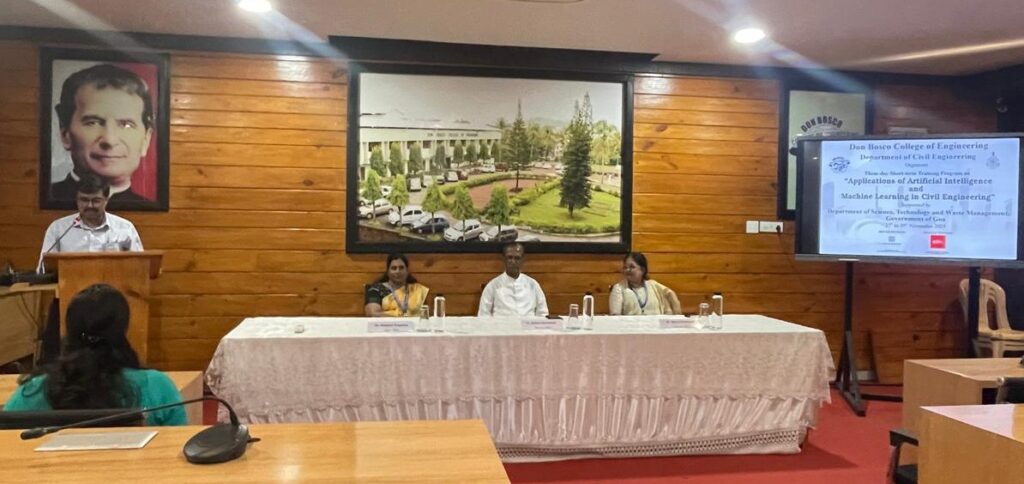
The Civil Engineering Department of Don Bosco College of Engineering, Fatorda, organized a Short Term Training Program on “Applications of Artificial Intelligence and Machine Learning in Civil Engineering” from 27 to 29 November 2025. The event was coordinated by Asst. Prof. B. R. Anirudha and Asst. Prof. Prachi Dessai.
The inaugural ceremony took place at 10:00 AM on 27 November 2025 in the presence of Chief Guest Er. Olavo Carvalho, Director Rev. Fr. Wilfred Fernandes, Principal Dr. Neena Panandikar, Head of Department Dr. Shwetha Prasanna, and Dr. N. V. Umamahesh. The dignitaries addressed the gathering and emphasized the growing significance of AI and ML in civil engineering, the objectives of the training program, and its potential to enhance the skills of students and professionals.
Day 1 – 27 November 2025
Session 1: “Application of AI and ML in Hydrology and Water Resources” (11:45 AM – 1:00 PM)
Speaker: Dr. N. V. Umamahesh
Introduced by: Asst. Prof. Vanessa Fernandes
The session focused on the increasing relevance of modelling in hydrology, highlighting how climate variability, data complexity, and uncertainty demand advanced AI, ML, and Geo-AI methods for accurate prediction and decision-making. The session concluded with a memento presented by Dr. Shwetha P.
Session 2: “Introduction to AI and ML in Civil Engineering” (2:15 PM – 3:45 PM)
Speaker: Dr. Shreyas Simu
Introduced by: Asst. Prof. Genevieve Fernandes
The speaker covered AI domains and approaches, the ML framework, algorithms, fuzzy logic systems, and associated challenges in civil engineering applications. A memento was presented by Asst. Prof. B. R. Anirudha, marking the end of Day 1.
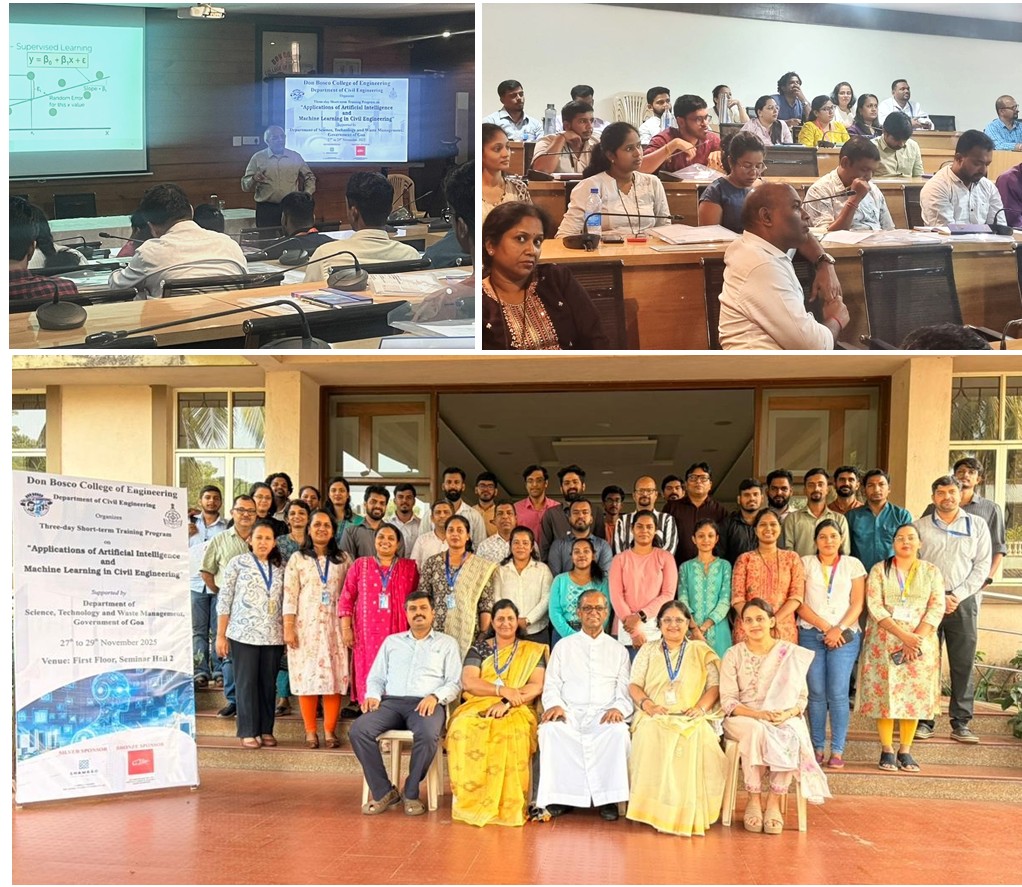
Day 2 – 28 November 2025
Session 1: “Applications of AI and ML in Civil Engineering” (10:00 AM – 11:30 AM)
Speaker: Dr. Gaurang Patkar
Introduced by: Asst. Prof. Jonessa Ferrao
The session discussed the five key elements of AI, the need for AI in the restoration of ancient structures, and various structural conservation techniques. A memento was presented by Dr. Shwetha P.
Session 2: “Application of AI in Remote Sensing and GIS” (11:45 AM – 1:00 PM)
Speaker: Dr. Shaahank Bangi
Introduced by: Asst. Prof. Swaroopa Sail
The speaker highlighted applications of AI in satellite imagery, spatial datasets, and geospatial analysis to enhance mapping, prediction, and monitoring in civil engineering.
Session 3: “Application of AI and ML in Environmental Engineering” (2:15 PM – 3:45 PM)
Speaker: Dr. Sanjeev Sangami
Introduced by: Asst. Prof. Shruti Jambhale
This session elaborated on AI and ML applications in wastewater treatment, pollution monitoring, environmental modelling, and sustainability assessments. The day concluded with a memento presentation by Dr. Nityendra Palankar.
Day 3 – 29 November 2025
Session 1: “Vibration Signature Analysis Using AI/ML for Fault Detection and Health Monitoring” (10:00 AM – 11:30 AM)
Speaker: Dr. Ramprasad Joshi
Introduced by: Associate Prof. Dr. Nitendra Palankar
The session focused on vibration-based monitoring, feature extraction, and ML-driven fault detection in structural and mechanical systems. A memento was presented by Dr. Shwetha P.
Session 2: “Geotechnical Risk Analysis Using Artificial Intelligence” (11:45 AM – 1:15 PM)
Speaker: Dr. Piyush Samui
Introduced by: Prof. Starina Dias
The speaker discussed AI-enabled analysis of geotechnical risks, including slope stability, settlement prediction, soil behaviour modelling, and uncertainty quantification.
Session 3: “AI Models for Pavement Materials and Technologies” (2:15 PM – 3:00 PM)
Speaker: Dr. Aniket Vasantrao Kataware
Introduced by: Associate Prof. Dr. Nitendra Palankar
The session covered AI-based prediction models for pavement performance, material characterization, and emerging pavement technologies.
The program concluded with an online quiz, followed by the Valedictory Function. The session included a workshop overview by Asst. Prof. Genevieve Fernandes, participant feedback, certificate distribution, and a vote of thanks delivered by Event Coordinator Asst. Prof. B. R. Anirudha.
The three-day training program successfully provided a comprehensive understanding of how AI and ML can transform various domains of civil engineering. Through expert-led sessions, practical insights, and active participation, the workshop met its objective of fostering technological advancement and enhancing skill development among learners and professionals.


 Visit Today : 670